Schematic 16F684
The signal LEDs are in the lower left. They are labeled
appropriately in the schematic. Note that the current limiting
resistor between the LED and the 12 volt power supply is marked
"??K" as this value must be determined by the end user.
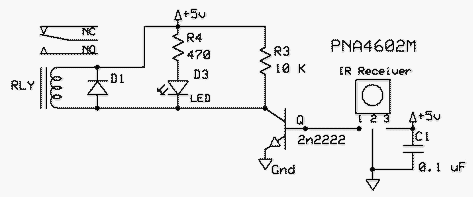
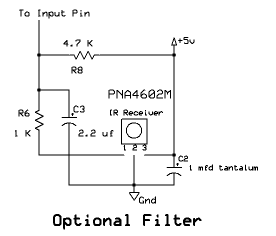
If the power supply is noisy the following filter, composed of C3
and R8, is suggested to clean up the pulses from the detector.
Note that the additional 100 mfd electrolytic cap in the schematic
above (C3) may make this filter unnecessary in most applications.
 |
Software
'3-19-08 Crossing Signal
Control - manages two sets of two lights
' for Dave S.
'4-4-08 - revising to ignore noise and false hits
' capacitor added between ground and IR sensor output pin to
filter out noise
' used 100 mfd or 220 mfd electrolytic on board
DEFINE DEBUG_REG PORTA
DEFINE DEBUG_BIT 4 ' PIN 3 on 16f684
DEFINE DEBUG_BAUD 9600
DEFINE DEBUG_MODE 1 ' Set Debug mode: 0 = true, 1 = inverted
'define PULSIN_MAX 555
ansel = 0
cmcon0 = 7
Include "modedefs.bas"
IR_Sensor var portc.2 'pin 8
Signal1_Green var porta.5 'pin 2
Signal1_Yellow var porta.2 'pin 11
Signal2_Green var portc.4 'pin 6
Signal2_Red var portc.3 'pin 7
temp var word
trisc = %00000100
trisa = %00000000
debug 13,10,13,10,"Crossing Controller IR",10,13,"(C) 2008 -
d. bodnar - ver 1.1x",13,10,"TrainElectronics.com",13,10
hpwm 2, 127,38000 '50% duty cycle @ 38kHz portc.5 - pin 5
Start:
'debug "Start", 10,13
high signal1_green
high signal2_green
low signal1_yellow
low signal2_red
if ir_sensor=1 then
for temp = 1 to 3
debug "temp= ",#temp, 10,13
if ir_sensor=0 then start 'make sure it was not a false
signal
next temp
goto GotGoodHit
Endif
goto start
GotGoodHit:
debug "got good hit", 10,13
low signal1_green
low signal2_green
high signal1_yellow
high signal2_red
StayHere:
for temp=1 to 50000
if ir_sensor=1 then
debug "saw rehit", 10,13
goto stayhere
endif
next temp
debug "train has passed... pausing", 10,13
pause 10000
debug "Returning to top", 10,13
goto start:
|
|
| Circuit Board The control unit is made up of two
boards. The first board contains the power supply circuit, the
microcontroller and the interface for the infrared sensors.
The sensor connects through the four wires that go to the right.
The secondary board connects through the six wires that go to the
left. Power is supplies through the red and black wires at the
bottom. The blue and white wires go to the PC's serial port
for testing. They will not be on the finished circuit.

A good bit of rework was needed on the bottom of the board to
accommodate this circuit.

The second board supports the four TIP 101 Darlington transistors
that power the signal lights and the screw connectors that connect
to the signals. The negative terminal of each connector is
marked in black. If LEDs are used in the signals proper
polarity must be observed.
Red, Green and Yellow LEDs were used for testing.

The connections for the signal lamps are clearly marked on the
terminals. Note the black on the top of these terminals
indicating the negative connection.


The back of the secondary board is shown here.

|


